24. Region Luxeuil - Saint Valbert - Luxeuil

Bourgogne-Franche-Comté
24. Region Luxeuil - Saint Valbert - Luxeuil
Easy
6h
18,8km
+326m
-326m
Embed this item to access it offline
The route takes place mainly in woodland on both the outward and return legs. The first third follows the signposted route of a stage of the Via Columbani between Luxeuil and Annegray, where Saint Columban arrived from Ireland in 590.
Identical to the presentation photo, these markers feature a QR code that can be used to display the topo guide for this stage on mobile phones or tablets, and to follow the route on a map by geolocation.
Identical to the presentation photo, these markers feature a QR code that can be used to display the topo guide for this stage on mobile phones or tablets, and to follow the route on a map by geolocation.
10 points of interest
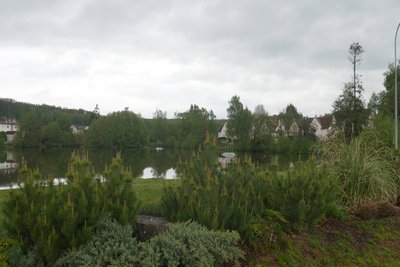
Étang de la Poche à Luxeuil-les-Bains - Amis de saint Colomban TouristThe Morbief and the Etang de la Poche at Luxeuil-les-Bains
The Morbief was dug by the monks of the Abbey of Luxeuil in the 12th century to supply water to the monastery's tanneries. A stream used to run through the lower part of the town, it was fed by the springs of the Banney forest that you will cross at the beginning of your stage. The Morbief's water intake is upstream in the Breuchin valley at La Lie aux Moines and crosses the town to join the Breuchin towards the west. From the 18th century onwards, the canal was used as a source of hydraulic power for the first ironworks. Today it has become a place for walking.
In order to have a regular flow of the canal the monks built the Etang de la Poche, still active for the regulation of the canal, and the Etang Saint-Valbert, which has now disappeared.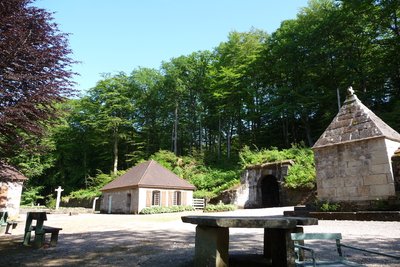
L’Ermitage restauré en 1960 par les Amis de saint Colomban - Amis de saint Colomban St ColumbanHermitage of Saint-Valbert
Of all the men who illustrated Luxeuil Abbey, Saint Valbert is without doubt the one who had the greatest influence and whose memory has been best preserved.
Around 620, a young lord on horseback, fully armed, presented himself to the monastery in front of Abbot Eustaise. He wanted to flee the world and devote his life entirely to the service of God: his name was Valbert or Waldebert (in the popular language Vaubert or Gaubert).
According to the monk Adson who wrote his life 250 years after his death, the future Saint retired as a hermit in the forest 5 km from the monastery of Luxeuil. This is where the monks of Luxeuil came to get him in 630, after the death of Abbot Eustaise. Valbert succeeded him, continuing the work of his predecessor, a disciple of Saint Colomban. Under the abbatiate of these two abbots, the monks of Luxeuil swarmed several dozen monasteries in Gaul during the 7th and 8th centuries. This site was saved from oblivion and embellished by Doctor Gilles Cugnier, president of the Association of Friends of Saint Colomban in the 1960s.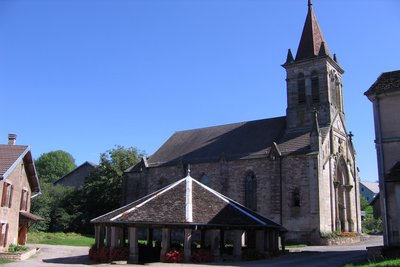
Église saint-Valbert - Amis de saint Colomban TouristVillage of Saint-Valbert
The date of the creation of the village of Saint-Valbert is not known, but it is very likely that its history is confused with that of the monks of Luxeuil. As early as the High Middle Ages, sarcophagi were extracted from the quarries near the hermitage of Saint-Valbert. The first quarrymen, monks and laymen lived in the village, which was supplied by numerous springs.
Today one can admire the 19th century church, superbly restored in 2017, and the nearby wash-house. A very dynamic commune of 200 inhabitants.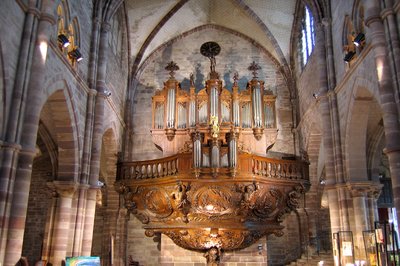
Orgue de l’église abbatiale de Luxeuil-les-Bains - Amis de saint Colomban St ColumbanBasilica of Saint Peter and Saint Paul at Luxeuil-les-Bains
When, in 590, Saint Columban, a monk from Ireland, decided to found a monastery among the ruins of the ancient Luxovium, his first concern was to build a church, probably a modest one, around which the cells of his first disciples were grouped. Since that time, several churches have been rebuilt following destruction and fires, but always on the same site. Since no archaeological excavations have been carried out in the basilica, it is difficult to reconstruct the history of this church. During the laying of the hot-air galleries at the end of the 19th century remains of walls not symmetrical to those of the church were discovered and many sarcophagi.
The construction of the present building began in 1215 and was completed in 1330. While cathedrals were being built in France, the monks preferred the rigour and austerity found in Cistercian churches of that time. The Gothic style rubbed shoulders with the Romanesque style reflecting the architectural evolution of the buildings in the 13th and 14th centuries.
Admire the most beautiful organ case in the region dating from 1617, still in perfect condition. The pulpit comes from Notre-Dame de Paris deposited in the 19th century at the request of Viollet-le-Duc who judged the piece of furniture to be not in conformity with the Gothic style of the Parisian cathedral. The choir stalls come from the cathedral of Saint-Etienne de Besançon destroyed by Vauban to build the citadel.
The Cloister
Together with the former abbey church, the pink sandstone cloister is the last medieval element of the Benedictine monastery of Luxeuil.
On the keystones of the vault, one can discover the coats of arms of three successive abbots who contributed to its construction in the 15th century. Although one of its wings was amputated during the Revolution and all but one of its arcature decorations were removed, it offers visitors an ideal setting to stroll around admiring the south façade of the abbey palace, begun in 1550 and completed a century later.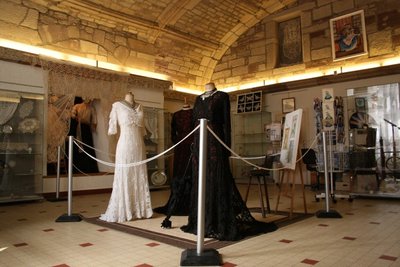
Conservatoire dentelle de Luxeuil - Amis de saint Colomban TouristLace Conservatory of Luxeuil
The particular fame of the lace of Luxeuil is essentially due to the enormous diffusion which it knew under the second empire. Until the Second World War, embroidery occupied dozens, even hundreds of female workers in the town and the surrounding communes.
At the conservatory: discovery of lacemakers at work and exhibition of needlework and original creations. Practice of lace and introductory and advanced courses.
Free visit from 2pm to 5.30pm on Tuesdays and Fridays.
Free entrance.
More informations : la Dentelle de Luxeuil website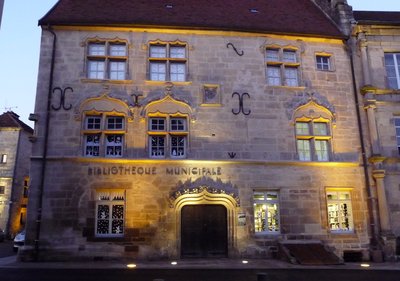
Maison Thiadot dite maison du Bailli à Luxeuil-les-Bains (15e siècle) - Amis de saint Colomban HistoricalRenaissance style houses in Luxeuil-les-Bains
From the 14th to the 15th centuries the town of Luxeuil was independent from the County of Burgundy. Merchants benefited from a favourable tax regime compared to that of the County of Burgundy. This must have been the main reason for the establishment of a Lombard family, the Jouffroy, trading in cloth between Flanders and Lombardy. They left us the two most beautiful buildings of the city, the house known as the house of Cardinal Jouffroy and the Aldermen's Tower which houses a museum. Its stone balcony is one of the oldest in France, observe the facade with its richly decorated gargoyles.
The Maison du Bailly (Thiadot Hotel, 15th and 16th centuries) and the house known as "François 1er" (which has no connection with the King of France) are worth a visit.
QR codes are affixed to the buildings for your information.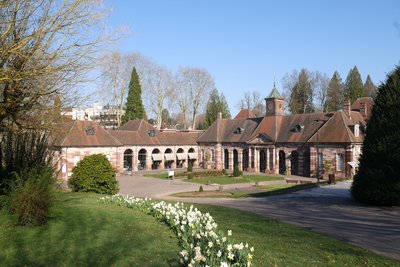
Ensemble thermal de Luxeuil-les-Bains - Amis de saint Colomban TouristThe Luxeuil-les-Bains Thermal Baths
With hot springs at 63° the site was occupied by man long before the Gallo-Roman period. In the 18th century, ex-votos discovered during construction work and exhibited in the Museum attest to traditions prior to the Christian era.
During the first and second centuries Luxovium prospered, merchants and craftsmen settled down as the Gallo-Roman stelae of the Alderman's Tower Museum, the most important collection in Franche-Comté, testify.
The destructive invasions of the 3rd to 5th centuries darkened Luxovium's rich past. On the arrival of the Irish monks at the end of the 6th century there is mention of the thermal baths at Luxeuil in the Vita Columbani.
The thermal waters were probably exploited during the Middle Ages but it was not until the 18th century that a thermal building was built on the springs, captured by the Romans, which filled the alabaster-covered basins still present in the 18th century.
In 1768 the new thermal establishment is inaugurated, today the building is classified Historical Monument, it is the oldest in France. During the centuries, the interior underwent many improvements following the degradation of the sandstone by humidity. Still today, important investments are made every year to maintain the services and comfort desired by the curists.
Do not hesitate to take a moment of relaxation in the thermal swimming pool or to take advantage of the beneficial treatments for the muscles of a seasoned walker.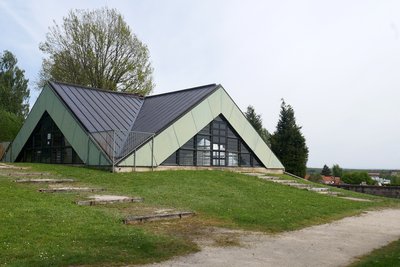
Site des fours de potiers Luxeuil-les-Bains - Amis de saint Colomban HistoricalThe potters' kilns at Luxeuil-les-Bains
Luxeuil ceramics: a major activity in the ancient city of Luxovium.
The kiln workshop is located behind the present municipal cemetery. On this small hill several springs gush out, the clay soil and the wood from the forest justify this location.
In the 1980s, Philippe Kahn and a few volunteers unearthed this exceptional site.
The site has 9 kilns, some of which are well preserved, such as the terracotta tubular pipe kiln, which made it possible to increase the firing temperature to obtain a shiny and robust sigillé, very rare in the north of Lyon.
A furnace for amphoras is a testimony to this activity which allowed the transfer of liquids, wines, oils...
Originally the site occupied more than one hectare but the extension work on the cemetery around 1950 reduced the archaeological area.
Visits are organised by the Tourist Office.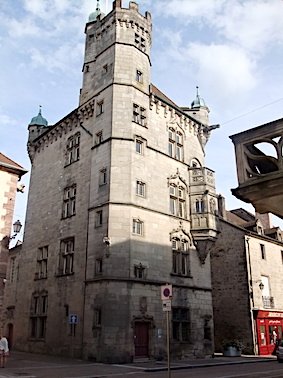
Tour des Echevins Luxeuil les Bains - Tour des Echevins Luxeuil les Bains TouristÉchevins Tower Museum
This belfry was built at the end of the 15th century by Henri Jouffroy, son of a rich Luxembourg merchant. In 1552 the notables moved into the building to hold council and thwart the decisions of the Abbot of the monastery concerning the management of the town.
In 1673, the council decided by decree that all objects discovered during excavations in the town were to be deposited in the Aldermen's Tower. This decree means that the Musée de la Luxeuil is one of the oldest museums in France.
An important collection of Gallo-Roman stelae and Gallic ex-votos are on display.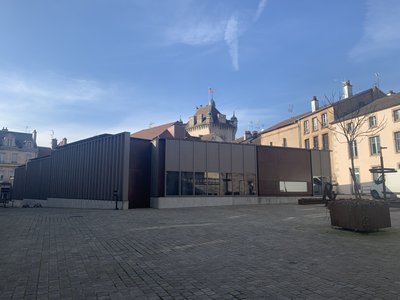
Amis saint Colomban St Columban&cclesia
In 2006, an early Christian church complex was discovered on the Place de la République in Luxeuil-les-Bains. A major archaeological dig was carried out from 2006 to 2010 by archaeologists from all over Europe and the Americas, under the direction of CNRS archaeologist Sébastien Bully.
The life of Columban (Vita Columbani), written around 640, mentions Luxovium as an abandoned castrum. Recent archaeological research has led to an in-depth re-reading of the conditions under which the first monks settled here, demonstrating the continuity of the settlement's occupation and the presence of an early Christian community by reusing elements of early Christian and ancient monuments. The Place de la République (formerly the Place Saint-Martin) has revealed the presence of a funerary church dating from the late 5th and early 6th centuries. More than a hundred sarcophagi covering an area of 600 m2 have been discovered.
The &cclesia, the site's interpretation centre, opened in 2021.
Luxeuil's rich archaeological heritage still leaves plenty to be discovered for future generations. On the Place de Baille, next to the current site, a church dedicated to Notre-Dame dating from the same period as the church of Saint-Martin was recently discovered. Future generations will be able to make the most of this site.
Find out more.
Description
The route starts in front of the statue of Saint Colomban next to the entrance to the basilica:
- The first marker is located at the foot of the statue. Marking or downloading the stage using the dedicated QR code takes you along the Poche pond and follows the Morbief stream. The exit from the town is marked by a tunnel under a busy road after the Auchan shopping centre.
- The trail continues through the forest after the picnic area and the forest house on a winding track near the N57 for 1.5 km. Cross the N57 national road via a bridge.
- After the bridge, leave the signposting and turn right then left after 100m onto a forest track heading east then north. At the junction with a tarmac track, turn right towards La Maisonnette. Continue along the forest track heading north-east for 1km.
- The track joins the signposted route which continues eastwards. Turn left towards the west for 1 km to reach the hermitage of Saint Valbert, a historic site with a fountain, grotto and gardens set in a forest. Take the tarmac road (800m) to the hamlet of Saint-Valbert.
- After the church, take the road between the wash-house and the town hall, then turn right (towards Fougerolles). After 100m, leave the main road and turn left up the Chemin du Haut du Ban. On the ridge, the track heads south. At the next crossroads, turn right onto the track, cross the road carefully and head north along the N57 below.
- Cross over to the left on the bridge over the N57 and turn left immediately afterwards. Continue southwards for 500m and turn right before reaching a tarmac road. Follow this for 1.5km before reaching a tarmac road. Cross it, take the track opposite for 100m then turn right to reach another road.
- Carefully cross this road and then turn left onto the track running south-west. Follow this track for 700m before taking another track heading east to reach the town of Luxeuil, the thermal baths and the return to the starting point.
- Departure : 70300 Luxeuil-les-Bains (basilica)
- Arrival : 70300 Luxeuil-les-Bains (basilica)
- Towns crossed : Bourgogne-Franche-Comté
Altimetric profile
Access and parking
The starting point is at the foot of the statue of Saint Colomban next to the Saint-Pierre de Luxeuil basilica.
The nearby car park on the Place de la Baille is accessible via the town's main street (rue Victor Genoux).
The nearby car park on the Place de la Baille is accessible via the town's main street (rue Victor Genoux).
Report a problem or an error
If you have found an error on this page or if you have noticed any problems during your hike, please report them to us here: