
Via Columbani News
July/August 2026
Welcome to the Via Columbani Partnership Newsletter!
This newsletter highlights some of the key events and developments of recent months.
The years 2026 and 2027 have been dedicated by the Partners to strengthening collaboration between the countries that commemorate the memory of Columbanus and Gall.
The Via Columbani is “a route across Europe, bringing communities together”. The development of the route is central to the project. In March 2026, the Via Columbani was present at the Lyon Hiking and Outdoor Recreation Fair, making connections with the world of tourism and hiking. These connections involve other European pilgrimage routes, such as the Way of St James and the Via Sancti Martini.
In each country, the route is strengthened through contacts and collaboration with local authorities; also through organised walks and the installation of waymarking. This edition of the newsletter summarises recent initiatives undertaken, including the creation of shorter-distance circuits and routes, as explained in last November’s newsletter.
Another important aspect of the collaboration is the cultural and educational exchanges carried out in partnership with the Peregrinus project, most recently between Italy, Northern Ireland, the Republic of Ireland and France. An example of the work is presented in this edition.
These exchanges often highlight other figures from the ‘Irish movement’ that spread across Europe between the 7th and 10th centuries, in addition to the emblematic figure of Columbanus. One notable example is Saint Brigid of Kildare, who never left Ireland but who is still venerated today in Brittany, Alsace-Lorraine and northern Italy.
A first trade fair for the Via Columbani

Welcoming more than 350 exhibitors and nearly 12,000 visitors in 2026, the Lyon Salon du Randonneur (Hiking and Outdoor Recreation Fair) is an ideal place for networking and sharing information, attracting a growing number of enthusiasts with a wide range of motivations and interests.
For the first time, the Via Columbani took part in the fair from 20 to 22 March 2026, alongside many other routes, including the Way of St James, the Via Sancti Martini and the Via Francigena. The fair provided us with opportunities to share experiences while raising awareness of our route.
Through its online mapping, the Via Columbani was able to highlight the 5,130 km of routes in France dedicated to the memory of Saint Columbanus, as well as the European network, which crosses nine countries between Ireland and Italy.
We were particularly pleased to welcome to our stand Wolfgang Sieber, President of Kolumbansweg, the association responsible for the Via Columbani route through Switzerland, Austria and Liechtenstein. That enabled us to present the short routes and circuits (over one or several days) currently being developed in Switzerland and Austria, in France, and soon in other countries. (See the following article.)
Building on this experience, the Via Columbani will be present at the next Lyon Salon du Randonneur, which will take place from 19 to 21 March 2027.
Developing the route
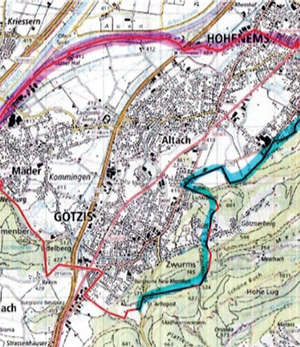
In our November issue, we presented the circuits and routes designed for walkers wishing to undertake shorter distances (one to five days). These can be promoted through tourist information offices, hotels and other service providers.
The first of these have been developed along the Kolumbansweg in Switzerland and Austria. The map opposite shows the circuit around Hohenems and Götzis, where two branches of the Via Columbani diverge: one passes through Austria and Liechtenstein towards the Septimer Pass; the other crosses Switzerland via Grabs, Sargans and Chur.
A collaboration has been established between the Kolumbansweg and the St Gall Pilgrims' Hostel, with organised walks along these routes in May and June this year, and another planned for September, which will also cross Vorarlberg (Austria) and Liechtenstein.
The French Federation of the Via Columbani, for its part, is organising numerous walks in France, as well as further afield. In July, a walk will take place around Bobbio (Italy), and in November another will be organised on the Via Sancti Martini, in the Tours area.
In June, a walk was organised between Annegray and Basel. Although this route was not travelled by Saint Columbanus, it provides a walking link between Luxeuil-les-Bains and Switzerland for those wishing to continue their pilgrimage along the Kolumbansweg towards Italy.
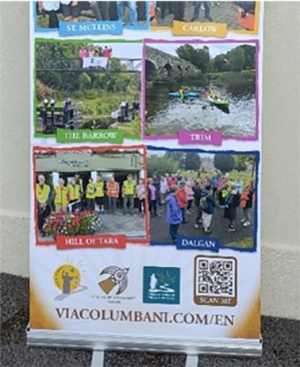
During 2026, the Turas Columbanus / Columban Way in Ireland has also seen an increase in the number of organised walks along its 571 km. This momentum has largely been driven by local community organisations, supported by the charitable organisation ‘Knights of Columbanus’. The walks have promoted a range of values, including well-being, heritage, peace and reconciliation. Funds raised are donated to local charities.
The first walk of the year took place on 20 June, bringing together 45 pilgrims who walked the thirteen kilometres between Clonard and Trim in County Meath. Some walkers continued part of the journey by water, using kayaks and boats, recalling the time of Columbanus, when inland waterways were certainly among the most common means of transport.
Soon after (July 25th), another walk was carried out in partnership with the Interfaith Forum of both Dublin and Northern Ireland along the border counties of Monaghan (RoI) and Fermanagh (N.I) , a place of great beauty but also carrying the scars of ‘The Troubles’ (1968-2014) as well as earlier waves of emigration (https://columbans.ie/walking-together-on-annual-interfaith-pilgrimage). We remember that the Via Columbani (‘Turas Columbanus’ in Irish and ‘Columban Way’ in English) crosses this national border and thus automatically presents itself as a route of peace and reconciliation.
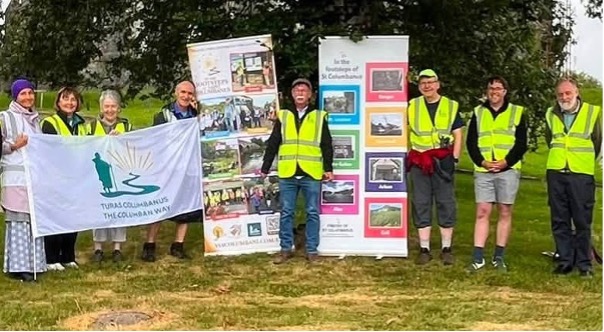
Further walks are planned in the counties of Carlow, Monaghan and Fermanagh over the coming months. They will offer pilgrims the opportunity to discover Ireland's beautiful landscapes, showcase its rich heritage and promote regenerative tourism that benefits both the local areas and their communities.
Fermanagh is in Northern Ireland. The Via Columbani (‘Turas Columbanus’ in Irish and ‘Columban Way’ in English) crosses this border and presents itself as a route of peace and reconciliation.
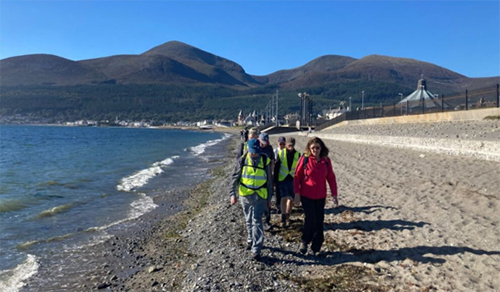
Closer to Bangor, the Friends of Columbanus (FOCB) also organise numerous walks. In June, a spectacular route was followed between Newcastle and Dundrum in County Down, passing along the beach in the shadow of the Mourne Mountains. Another walk is planned for September between Comber and Newtownards.
Educational projects forge European ties
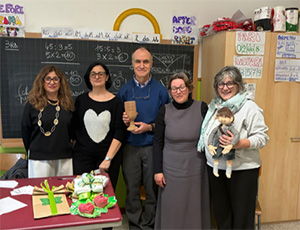
From 27 February to 4 March 2026, Sharon Kayes, Education Officer of the Friends of Columbanus, Bangor (Northern Ireland), visited the Piacenza region in northern Italy to make contact with schools interested in European cultural exchanges, accompanied by Pat Colgan, vice-president of the Via Columbani Partnership.
The visit was organised by Manuela Bertoncini, coordinator of the Peregrinus project, through which the Partnership carries out educational projects throughout Europe. Peregrinus' mission is to forge and strengthen links between individuals and institutions, in regions where the message and legacy of St Columbanus and his monks are still alive.
In the primary and secondary schools of Santa Franca in Vernasca, the visits were dedicated to Celtic/monastic themes, peace, biodiversity and the links between the peoples of Europe. The younger children were won over by the Saint Columbanus puppet and by the sound of the Irish tin whistle, played by Pat. The older classes were eager to use their English to discuss the highlights of their village and region.
The next day, the group travelled down to Lugagnano (in the Val d'Arda plain) for discussions with the staff and pupils of the ‘Instituto Comprehensivo’. It became apparent that the pupils were already well acquainted with the history of the Irish monks and the nine countries crossed by the Via Columbani.
The visit was enriched by a meeting with Father Paolo Capra, parish priest of Piacenza, who hopes to organise visits of Italian pilgrims to Ireland in the next few years. He also plans to reopen the historic Piacenza hostel for Irish pilgrims on their way to Bobbio and Rome, a hostel (and hospital) which originally dates back to the ninth century.
Bringing to life the heritage of Saint Brigid
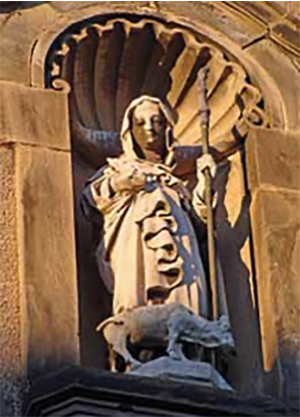
When Columbanus left Bangor in the year 591, he was not the first Irish monk to have departed for the continent of Europe on a ‘peregrinatio pro Christo’ and by no means the last. Between the 7th and 10th centuries of our era, there are many historical references to Irish monks at the courts of kings and nobles.
Between Ireland and the great monasteries of Luxeuil and Bobbio founded by Columbanus there would have been many exchanges; and in the regions where Irish monastic sites were established or where Columbanus’ followers travelled, it is not unusual to find a church or parish dedicated to Saint Brigid who was, after Patrick, the most revered of the early Irish saints. In the photo : a statue of Saint Brigid, on the façade of church of Freyming.
On February 2nd, the Irish musicians Catriona McElhinney Grimes and Colette Delahunt were at the church of St Brigid in Ponzate, near Como, to celebrate the Saint’s feast day. The event was organised by the Peregrinus Project, a close collaborator of the Via Columbani Partnership in the field of cultural exchange.
In March of this year, the Vice-President of the Via Columbani Partnership, Pat Colgan, travelled to Piacenza with Manuela Bertoncini, coordinator of the Peregrinus Project, to visit the church of ‘Santa Brigida di Irlanda’. See previous article. Pat has a personal stake in the project. “My home parish in Belfast is also called St Brigid”, says Pat. “To strengthen the connection, we are inviting a group of young people from Ponzate and Piacenza to visit Belfast and Bangor this summer.”
These multiple connections can be found throughout Europe. In 2017, as the Partners were tracing the route of the Via Columbani pilgrimage trail through the Rhineland, they came across a ‘rue Sainte Brigitte’ in the village of Offendorf. The mayor of nearby Kilstett, Gabriel Muller, revealed the historic importance of Saint Brigid in that region, and the multiple links with Ireland and the Saint, including the use of the four-leafed clover as a symbol on churches, the widespread use of ‘Brigide’ or ‘Bride’ as a baptismal name for girls, and the rich annual festivities of February 1st.
The reason for these traditions lies in the shifting bed of the Rhine river. In the year 720, the monastery of Honau, a short distance away, was founded by Columban monks from Luxeuil, and remained influential until 1290, when the buildings had to be abandoned due to floods. In 1398, after further flooding, the monks were forced to move to the parish of Saint-Pierre-le-Vieux in Strasbourg. They took with them a reliquary of Saint Brigid that can still be seen in the sacristy of that church.
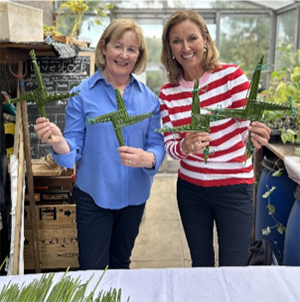
In Ireland too, St Brigid is a unifying figure. In Bangor this February, the heritage guide Brigid Watson organised a day dedicated to ‘Celtic Saints: a Journey through Time and Tradition’, that took place at the North Down Museum – just a few hundred yards from the Abbey where Columbanus was trained. This hands-on workshop explored ‘the shared qualities and leadership of Columbanus and Saint Brigid, a powerful and influential Christian leader of her time.’ In the photo: Brigid Watson with Claire McCollum of the BBC.
The cult of Saint Brigid is a cultural link across Europe, carried by the monks of the early Middle Ages. Many other connections remain to be explored, between early Irish saints and place names and traditions in France, Germany, Switzerland, Italy, and certainly other countries besides.