28-Balzers-Landquart region
14 points of interest
Eau Passug TouristPassug mineral water
Two sources are at the heart of the Allegra Passugger. While the origin of both mineral waters lies deep in the earth, the Theophilic spring in the Rabiosa gorge and the Allegra spring in Malix bring the water to the surface. The waters take up to 30 years to travel before they are collected. In the fissured schist rock of the Grisons they absorb all the precious minerals and trace elements that make them the elixir of life par excellence. The sources of the Rabiosa Gorge were first mentioned in 1562 and rediscovered in the 19th century. Since 1951, mineral water has been bottled and distributed on the current site.
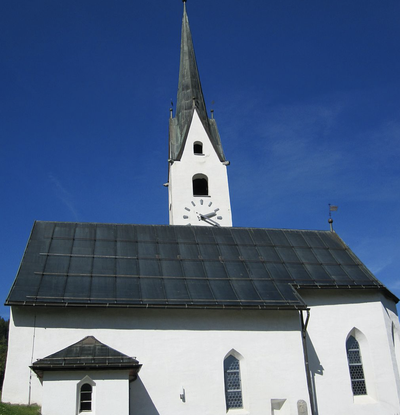
Église réformée - Amis St Colomban CulturalReformed Church
The Reformed Church dates back to a medieval foundation under the patronage of Gallus.
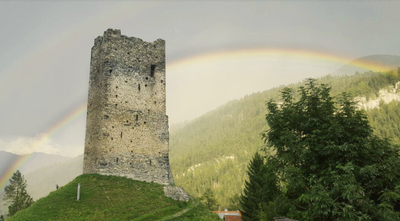
Château Strassberg HistoricalStrassberg castle
At the end of the 12th century, the castle of Strassberg was built on a hill to the south of the village. It was then given to the Barons of Vaz and formed the centre of a small estate. Today, only a ruin remains.
Read more about it.
 Historical
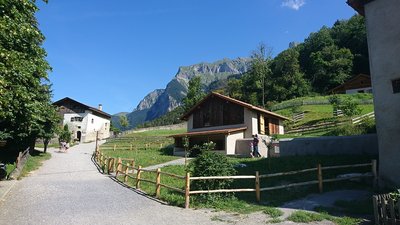
Heidi Museum
The story of Heidi, written in 1879 by Johanna Spyri, is a worldwide success. This book is one of the most widely read in the world. The story has been translated into more than 55 languages. Even today, thousands of people from all over the world visit Maienfeld, the museum and the Heidi fountain every year.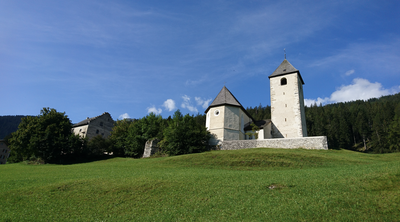
Église Ste Marie et St Michel - Amis St Colomban CulturalChurch of St. Mary and St. Michel
The monastery of Churwald, probably founded around 1150 by the barons of Vaz, is the origin of the village. The first Premonstratensian monastery church of the time was located near the bridge over the river Rabiusa. In the first half of the 13th century it was built on the present site in pre-Romanesque style and dedicated to St Michael.
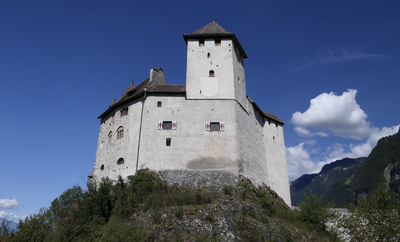
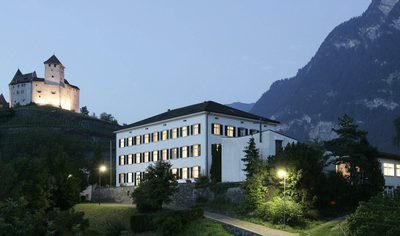
Château Gutenberg HistoricalGutenberg Castle
Visible from afar, Gutenberg Castle stands on a rocky spur that rises in the Rhine valley. The medieval castle was probably built around 1200. In the second half of the 13th century it belonged to the Barons of Frauenberg, who came from Graubünden. In 1314, Gutenberg passed to the Dukes of Austria and was then in Austrian possession for more than 500 years under the House of Habsburg. After 1750, the fortress was no longer inhabited, it was abandoned and turned into a quarry. In 1824, the municipality of Balzers bought the ruins of Gutenberg Castle and the associated estates. 30 years later they sold the Gutenberg ruins with the castle hill to Princess Franziska of Liechtenstein. In 1905, the Vaduz architect, sculptor and painter Egon Rheinberger acquired the poorly demolished complex and enlarged it between 1905 and 1910 to give it its present appearance. After several changes of ownership, the castle was bought by the State of Liechtenstein in 1979.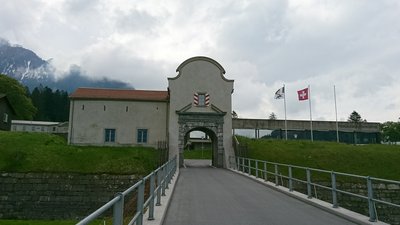 Historical
St. Luzisteig Fortress
Until the 19th century, the north-south route ran through the St. Luzisteig Pass, as the Rhine Valley was often flooded and impassable. The pass therefore played an important role in the major conflicts of European history. The road was part of the Roman road connecting Bregenz to Chur. The building spanning the road dates from 1702 and the site is still used today by the Swiss army as barracks (formerly for transport troops).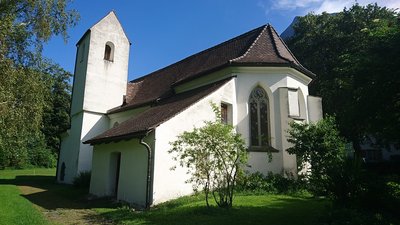 Cultural
Steig Chapel
The Steigkirche is first mentioned in 831. Until the beginning of the 15th century, the present building with its Late Gothic choir was the mother church of Maienfeld and Fläsch with its 14th and 15th century wall paintings.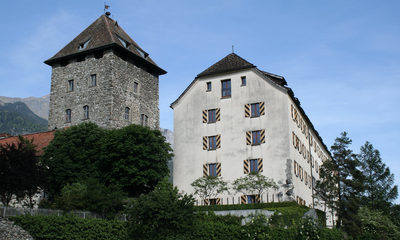
Château Brandis HistoricalBrandis Castle
Maienfeld played an important role in the first Christian century under the Romans as a customs post at the junction of the Turicum (Zurich) and Brigantium (Bregenz) roads. The present tower dates from the 10th century. Over the centuries the castle has developed from a fortress to a residence.
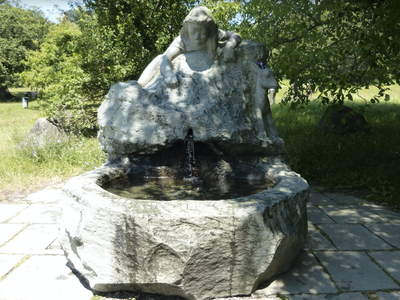
Fontaine Heidi CulturalHeidi Fountain
The Heidi Fountain was inaugurated in 1953 in memory of the writer Johanna Spiry, author of the famous novel about Heidi. The area is considered to be the home of this novel character with many activities around Heidi.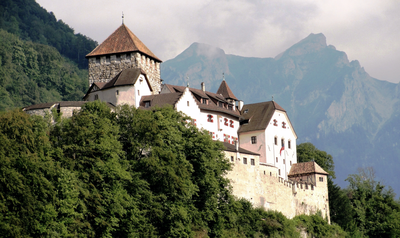
Château de Vaduz HistoricalVaduz Castle
The dungeon dates from the 12th century. The castle, a princely residence since 1712, has been enlarged and renovated over the centuries. Private property, it cannot be visited.
To know more about it.
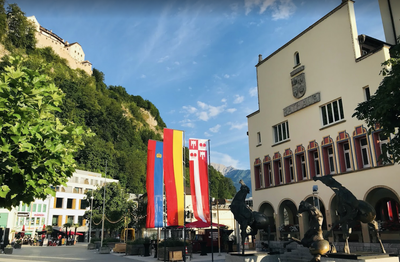
Vaduz HistoricalVaduz
Vaduz is first mentioned in 1175/1200. In 1699 Prince Hans Adam of Liechtenstein acquired the Schellenberg estate and in 1712 the county of Vaduz. In 1719, a treaty of Emperor Charles VI united the County of Vaduz with the Schellenberg Lordship and elevated it to the rank of an imperial principality with the name of Liechtenstein. Vaduz is the main town of the Principality of Liechtenstein and the residence of the prince at the castle above the town. Vaduz is also the seat of the state government and the archbishopric of the principality. The city is particularly well known as an international financial centre.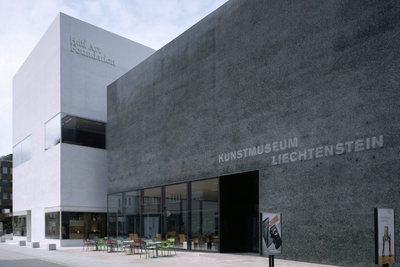
Musée Beaux Arts CulturalMuseum of Fine Arts
The Museum of Fine Arts in modern style was built by the Swiss architects Morger, Delego and Kerez and inaugurated in 2000. Numerous statues can also be found outside in the city.
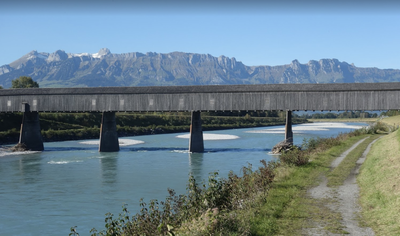
Vieux pont sur le Rhin HistoricalOld bridge over the Rhine
Only the flood protection dikes built after 1860 created the conditions for building bridges over the Rhine. Between 1867 and 1879, 13 covered wooden bridges were built in the Rhine valley. Of these 13, only the one near Sevelen has been preserved. All the others were destroyed by floods or fires or perished due to old age. On 8 July 1870, Sevelen decided to build the last remaining witness to the romanticism of the wooden bridge over the Rhine and to stop the Rhine ferry.
Description
- Continue straight ahead for 400 metres and turn left onto the fourth street (Iradug). Pass St Peter's Chapel (on the left) and continue along Iradug, which turns right before becoming a southbound path for 2 km, bringing you close to Grafen Castle. After two sharp bends, the path leaves the forest and turns south-east again after a right-hand bend (600 m). Continue in this direction for 1 km to reach Route 414, which leads to the Sankt Luzisteig military fort. Cross the barracks, which are still in use.
- Descend on the other side via the small road (No. 414 Steigstrasse). At the next roundabout, leave the road, walk along the car park and join the path at the edge of the forest, which then turns left (500 m) to rejoin the road. Cross the hamlet of St Luzisteig. After 200 m, take the path on the left that leads into the forest, then immediately turn right at the car park. Continue south-east for 2 km to cross a road and leave the forest. Continue in this direction and reach the hamlets of Bovel (600 m), Heididorf (400 m) and Rofels (300 m). Leave the hamlet heading south for 200 m.
- Take the first road on the left and then the next on the right (75 m), heading south-east again. This path (Oberer Rofelserweg) leads to the village of Jenins (1.5 km). At the Reformed church, the path follows the main road (414.02) heading south. At the village exit, turn right onto Selfiweg, which crosses the vineyards to the entrance to Malans (1.5 km). In front of the church, continue left (Heerengasse) to the fountain topped with a mouflon. Continue straight ahead (Sternengasse, Tobelgasse and Prättigauerstrasse) to cross the vineyards and two streams and reach the plain at the foot of the cliffs. In the valley, cross a stream and then a railway line.
- Before crossing the Landquart River, turn right and follow the riverbank for 3 km to reach the station, the end point of the hike.
- Departure : 9496 Balzers (Liechtenstein), St. Nicholas Church, Kirchensträssle
- Arrival : 7302 Landquart (Switzerland), railway station, Bahnhofstrasse
- Towns crossed : Balzers and Graubünden
Altimetric profile
Transport
The return journey can be made by train to Sargans and then by bus.
Report a problem or an error
If you have found an error on this page or if you have noticed any problems during your hike, please report them to us here: